
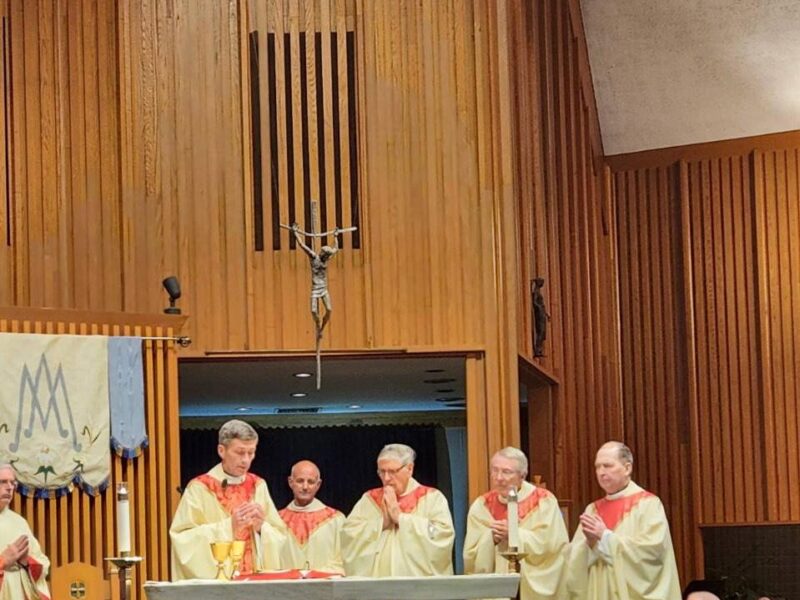
Over 75 years of Catholic Presence in the New Castle Area
Since 1948, Our Lady of Fatima has served as a Catholic Church and later a
K-8 school as well. Take a journey with us to see our past, present and future.
Liturgical Schedule and Events
Daily Liturgy (Held in the Chapel):
8:30am – Monday, Tuesday, Thursday and Friday
First Fridays of the month are held in the Chapel beginning after the 8:30am Mass with prayers and rosary.
Bilingual Confessions are held every Thursday at 6:00pm in the Church
Weekend Liturgy (Held in the Church):
Saturday – 5:00pm and 7:30pm (Spanish)
Sunday – 9:30am and 12:00pm
Confessions are held every Saturday before 5:00pm Mass, beginning at 4:00pm

Learn about all the current events going on in our Diocese

Join a Ministry
The Church lives through the nourishment of the Eucharist; “the celebration of the Eucharist …absolutely requires the presence of an ordained priest as its president” – Saint John Paul II, Eccelesia de Eucharistia, #29
Are you one of those men God is calling to serve the Church as a priest? If you think so, please call or write Father John Solomon, Diocesan Director of Priestly and Religious Vocations (302-573-3113), vocations@cdow.org
Could God be calling you to serve in a liturgical or musical ministry? We have a variety of ministries available for parishioners who would like to use their talents to help our parish. If you would like more information on how you could get involved, please click below.

Registration for 2026-2027 School Year:
Registration for Religious Education for the 2026-2027 school year is now open. We warmly invite families to enroll their children from grade 1-8 in our faith formation program, where they will grow in their relationship with
God, deepen their understanding of the Catholic faith and build a strong spiritual foundation.
If you would like to register your student or become a Catechist, please call Dolly Ibarrondo at 302-276-6078 with any questions or concerns.

Solemnity of the Most Holy Body and Blood of Christ
The Most Holy Body and Blood of Christ is also known as the Solemnity of Corpus Christi which translates from Latin to “Body of Christ.” This feast originated in France in the mid-thirteenth century and was extended to the whole Church by Pope Urban IV in 1264. This feast is celebrated on the Thursday following the Trinity Sunday or, as in the USA, on the Sunday following the feast.
This feast calls us to focus on two manifestations of the Body of Christ, the Holy Eucharist and the Church.
The primary purpose of the feast is to focus our attention on the Eucharist. The opening prayer at Mass calls our attention to Jesus’ suffering and death and our worship of Him, especially in the Eucharist. At every Mass our attention is called to the Eucharist and the Real Presence of Christ in it. The secondary focus of this feast is upon the Body of Christ as it is present in the Church. The Church is called the Body of Christ because of the
intimate communion which Jesus shares with his disciples. He expresses this in the gospels by using the
metaphor of a body in which He is the head. This image helps keep in focus both the unity and the diversity of
the Church.
The Feast of Corpus Christi is commonly used as an opportunity for public Eucharistic processions, which serves as a sign of common faith and adoration. Our worship of Jesus in His Body and Blood calls us to offer to God our Father a pledge of undivided love and an offering of ourselves to the service of others. We celebrate the true presence of the Body and Blood of Christ this week. How often do we overlook or take for granted this glorious truth? Recognizing and embracing this truth, one cannot help but be drawn to participate in this glorious mystery. Each time you receive the Holy Eucharist you are professing the true presence of Christ. As you partake in this mystery one should strive to embrace this in both their mind and heart. Another means in which one can contemplate this truth is through Adoration. When was the last time you spent time in the presence of Christ? Opening yourself up to this devotion is a wonderful way to affirm your faith, contemplate the mystery of Christ’s presence and witness to the fact that God truly dwells amongst us.

One adult from Our Lady of Fatima became a member of the Catholic Church and one other came into Full Communion with us at the Easter Vigil this year.
Are you or someone you know interested in learning more about joining the Church? Were you baptized as a child but have not yet celebrated the sacraments of Confirmation and Eucharist? New groups are forming now! For more information, please contact the rectory at 302-328-3431.

Father’s Day Novena
Father’s Day is just a few weeks away. If you wish to have your Father remembered in the Novena of Masses here at Fatima, please return one of the special envelopes provided at the exits of the Church. You can either put them in the offertory basket or drop them off at the rectory. Thank You.

Magnifica Humanitas
On May 25th. The 135th anniversary of Rerum Novarum, the Church’s first social Encyclical written by Pope Leo XIII, Pope Leo XIV released his first encyclical Magnifica Humanitas (Magnificent Humanity) on safeguarding the human person in the time of artificial intelligence. Bishop Koenig’s brief statement in gratitude for this document is below.
“Today, I join with my brother bishops in gratitude for our Holy Father Pope Leo XIV’s first encyclical Magnifica Humanitas on safeguarding the human person in the time of artificial intelligence, Signed on the 135th Anniversary of Rerum Novarum, the Church’s first Social Encyclical, this most recent encyclical draws upon the Church’s treasury of wisdom in order to helps us navigate this time of digital transition and both safeguard and nurture God’s gift of our magnificent humanity.
Magnifica Humanitas leads us through the discernment of what is just and right for the common good of
our shared humanity. Pope Leo calls us not to judge our use of Artificial Intelligence merely by its
effectiveness, but rather the human, social and spiritual bonds it enables or destroys.
As we navigate the most recent technological tool of artificial intelligence, may Magnifica Humanitas
assist us to follow the “way” of the ancient prophet of Nehemiah: “let us pray, plan wisely and work
perseveringly, placing God at the forefront of our actions and the human person at the center of our choices”
[Leo XIV,2026, 16] as we build with the tools of the digital age.
I also at this time bring to your attention a pastoral letter on Artificial Intelligence that was written by the Bishops of Maryland and issued on the Feast of Pentecost 2025 – “The Face of Christ in a Digital Age”. In this letter, my brother bishops and I reflect on the work of the Holy Spirit and the prophetic voice of the Church in guiding us in the use of the tools of Artificial Intelligence to serve and not diminish the innate human dignity of every person.
I hope that you will join me in reading and reflecting upon Magnifica Humanitas as we strive to work together in building a world where advancement is not judged merely by technological progress but rather assurance that every person is able to flourish as God made us to be – a magnificent reflection of Himself.”
Additional information on Magnifica Humanitas can be found on the diocesan website:
https://cdow.org/media-cetner/magnifica-humanitas.
“In an ever changing world, the Holy Eucharist is a constant reminder of the great reality of God’s changeless love.”
– Mother Theresa
